
Crochet a Cozy Lap Blanket with Icelandic Wool for Ultimate Warmth
Are you looking for a project that combines creativity, warmth, and practicality?
Crocheting a lap blanket offers just that!
Using Icelandic wool elevates your creation to a new level, thanks to its remarkable warmth, durability, and appealing texture. In this guide, I'll showcase the unique benefits of Icelandic wool, provide an easy pattern for a snug lap blanket, and share tips to enhance your crocheting journey, making it enjoyable and stress-free.

Why Choose Icelandic Wool?
Icelandic wool stands out because it originates from a special breed of sheep native to Iceland. These sheep have adapted to the harsh Icelandic landscape, producing a wool that offers unparalleled warmth and water resistance.

Key Features of Icelandic Wool:
Two-layer Structure: A long, water-resistant outer fiber (tog) that repels water and a soft, insulating inner fiber (Þel) that traps warmth. This unique combination makes the Icelandic Wool, lopi that is warm, lightweight, breathable and durable which makes this wool an ideal choice for cozy projects like lap blanket.
Colors: You can find Icelandic wool in a variety of natural shades, from soft grey to earthy browns, allowing for stunning crochet and knitting designs. The white wool of the Icelandic sheep is also dyed in yummy colors using sustainable and eco-friendly methods.
Locally made by Istex: The main manufacture of Icelandic Wool is Istex, which was established in 1896 in a city next to Reykjavik, Mosfellsbaer. The Icelandic farmers own more than 80% of the company and the wool is certified STANDARD 100 by OEKO-TEX.
Materials Needed for the lap blanket
Before you embark on your crocheting adventure, make sure you have the following materials on hand:
Icelandic wool yarn: Gather approximately 1000 grams of Lettlopi. This estimate depends on the size you prefer for your blanket. My lap blanket is 41"x66", just the right size when cozying up with a book by the fire.
Crochet hook: Use a 6 mm hook to achieve a loose stitch.
Scissors: For cutting threads. There are a few!
Tapestry needle: Essential for weaving in loose threads and assembling the blanket.
Equipping yourself with the right materials will lead to a smoother and more enjoyable crocheting experience.
Basic Crochet Stitches
If you are new to crocheting, familiarizing yourself with fundamental stitches is crucial. The main stitches used in this lap blankets include:

If you're new to crocheting, numerous really great online resources are readily available. I prefer picture tutorials, but choose any video or picture tutorials that provide step-by-step guidance for mastering these fundamental stitches.
A Lap Blanket Pattern with hexagons
Here’s a straightforward pattern to create a cozy lap blanket using Icelandic wool:
Step 1: Create hexagons, total of 144 + 18 half hexagons


For this lap blanket I used Lettlopi from left over projects, total of 14 different colors and light grey. It's made out of 144 hexagons
69 hexagons with rnd1 in colored yarn
65 hexagons with rnd1/rnd2 in colored yarn
10 hexagons with rnd1/rnd2/rnd3 in colored yarn
I then crochet 18 half hexagons to make the side of the blanket straight. I basically just took the pattern and halved the pattern and made a half hexagon. Forgot to take a photo, but hopefully you get my thinking.
Step 2: Sew the hexagon together
Now comes the fun part, designing the blanket and sewing the hexagons together. There are many ways to accomplish this, but I used a needle and went into the back loop of each hexagon, sewing the sides together and going around each hexagon linking it to the next hexagon making a solid surface.
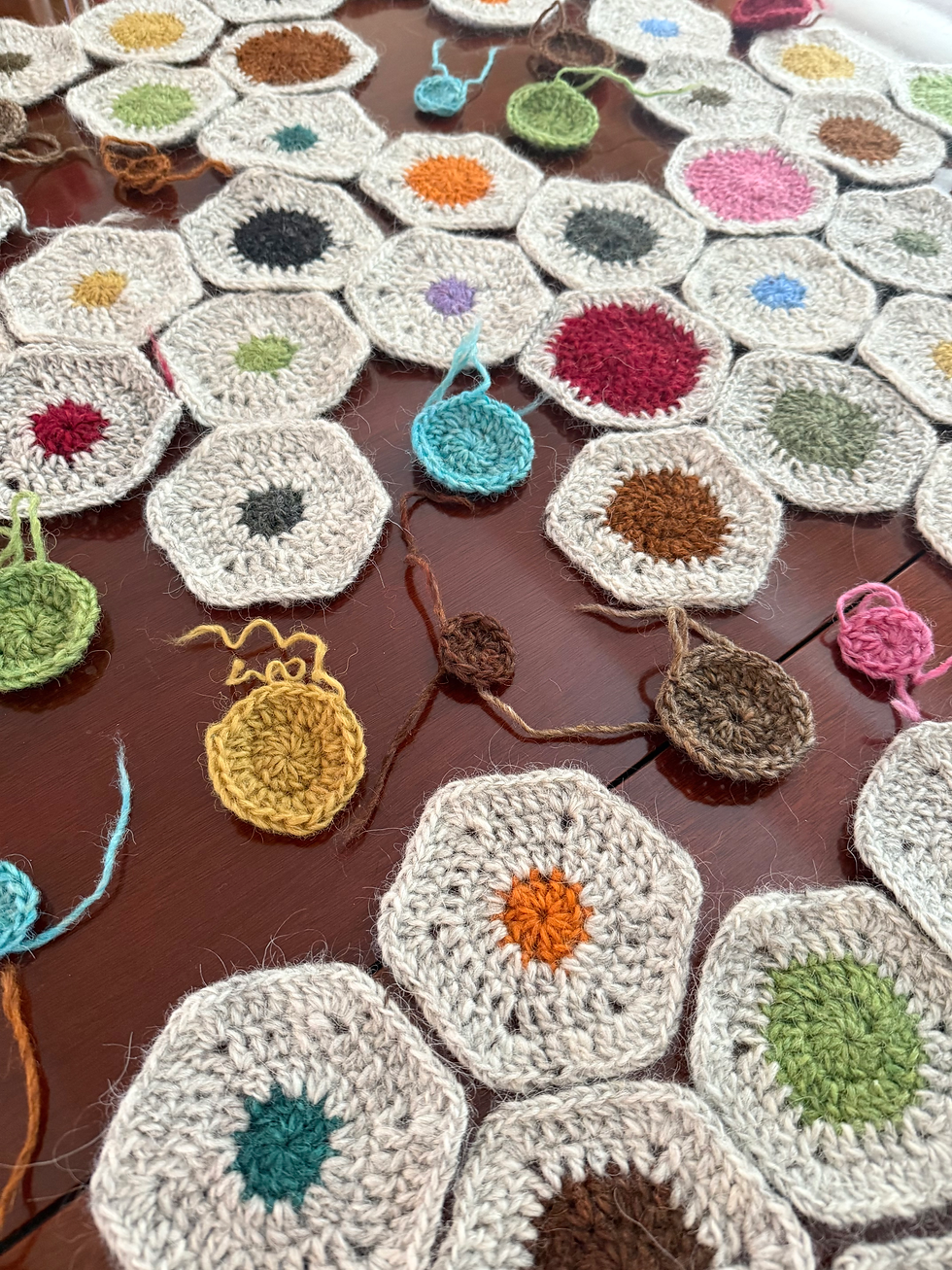


Basically you insert the needle into the back loop of two hexagons making sure they line up. Then you follow it around and sew the next one to it.
Step 3: Crochet a boarder on the top and bottom of the blanket
To make the blanket with straight border I crochet the following. On top of each hexagon I started with a sl st, then sc, half dc, dc, triple dc, then towards the center, where the hexagons joined I made 5 triple crochets that I crocheted together before I reversed the order of my stitching to fill in the space between the hexagons at the top and bottom of the blanket.

Step 4: Crochet a boarder around the blanket
I started with 1 row of dc into every stitch around the blanket to make it easier to make a smooth boarder. Then I stitched into every other stitch 1 dc with 1 ch between. In the next row I crocheted 1 dc into the chain stitch and 3 dc into each corner. This gave me a straight boarder and a finished look. As you can see on the picture below, I alternated light and colorful rows and used up nearly all my leftover yarn I had in my stash.

This was so much fun. Love this boarder as it's made with nearly every color that I hadn't already finished while making the hexagons. What a relief that I finally found a project to finish of all those left over skeins from various lopapeysu that I have knitted for my family through the years. All in all the boarder ended with 10 rounds of alternating light colors rows and bright colors rows, finishing of the blanket with back boarder.
It just needed a black row to finish of this lovely blanket, and the best part is that I used up around 1 kg of left over skeins of lettlopi in various colors that I had in my stash.
Helpful Tips for Working with Icelandic Wool
Gauge Swatch: Before starting your blanket it's advised to make a gauge swatch, but I didn't. Just make sure you always use the same size and make of needle. This will ensure your stitches match the required size, leading to uniform dimensions for your blanket.
Care Instructions: While Icelandic wool is naturally water-resistant, it is important to hand wash your blanket in cold water and lay it flat to dry. Avoid the washing machine, as it can lead to felting.
Explore Color Combinations: Do not hesitate to experiment with different colors of Icelandic wool. Try creating stripes, blocks, or even gradient effects for a look that's uniquely yours.
Comfort is Key: Crocheting can be a lengthy but fun process. Make yourself comfortable in a supportive chair, take breaks, and keep a cozy blanket nearby for extra warmth as you work. Hexagons can be made anywhere, it´s only when you start constructing the blanket that it needs to lay flat!

Wrapping It Up
Creating a lap blanket from Icelandic wool is a fulfilling project that not only keeps you warm but also acts as a functional piece for your home. Thanks to the unique properties of Icelandic wool, your blanket will remain cozy and durable for years.
Whether you are an experienced crocheter or just starting, this project is accessible and enjoyable. So gather your materials, find your favorite spot, and start crafting your very own cozy lap blanket. Mix up the colors, mix up the size of the colored center in each center. Find all your leftover lopi yarn and just start. You can't go wrong. Own your creativity, Own your design and have fun.
Happy crocheting!


Mình thích kiểu chơi xây nông trại và trồng trọt trong Minecraft, nên khi thấy bài về addon cây trồng và nông trại ở https://thuvienmc.com/addon-crops-farms-marketplace-download/ mình vào xem ngay. Trang giới thiệu khá chi tiết các loại cây và vật phẩm mới được bổ sung, kèm hình ảnh nên dễ hình dung khi đưa vào thế giới của mình. Phần hướng dẫn tải về trình bày rõ ràng từng bước, người mới chơi cũng làm theo được. Giao diện đơn giản, không bị quảng cáo che mất nội dung chính. Phù hợp cho những bạn thích lối chơi thư giãn, tập trung vào việc xây dựng và làm nông.
Mình có quan tâm đến phong thủy trong nhà ở nên hay đọc tham khảo trên vài trang khác nhau, trong đó https://phongthuy88.com/ là trang gần đây mình ghé qua theo lời giới thiệu của một người bạn. Nội dung trình bày khá dễ hiểu, không dùng quá nhiều thuật ngữ chuyên môn khó nắm bắt với người mới tìm hiểu như mình. Các bài viết phân loại theo từng chủ đề cụ thể, dễ tìm đúng phần mình đang quan tâm mà không phải đọc lan man. Giao diện đơn giản, không bị quảng cáo che khuất nội dung chính. Đây là nguồn tham khảo khá hữu ích cho ai mới bắt đầu tìm hiểu về lĩnh vực này.
I write casual reviews of browser games for a small blog, and block breaker google turned out to be a solid, no-frills take on the classic brick-breaker formula. What stood out was the responsiveness, paddle movement felt tight and precise, without any noticeable input delay that some browser games struggle with. No intrusive ads interrupting gameplay either, which is refreshing. Tested it across a couple of browsers and it performed consistently well in both. For anyone nostalgic for classic arcade-style games without wanting to install anything, this is worth a quick look.
Trong lúc tìm hiểu luckywin app mạng, mình tình cờ thấy trang này nên ghé vào xem thử. Mình chủ yếu chú ý đến cách bố trí và trình bày của trang. Nhìn chung, giao diện khá thoáng, các nội dung được sắp xếp thành từng khu vực rõ ràng nên dễ tìm kiếm. Thanh menu cũng được bố trí hợp lý, giúp việc chuyển đổi giữa các chuyên mục nhanh chóng và thuận tiện hơn.
Chủ đề “trang chủ chín.LUCK8 trang chủh thức” cùng những thông tin pháp lý tạo cảm giác khá chuyên nghiệp và chú trọng đến độ uy tín. Mình ghé qua để xem cách họ sắp xếp nội dung có dễ hiểu không. Giao diện khá đơn giản, bố cục chia thành từng khối rõ ràng, không quá nhiều màu sắc. Menu nằm ngay phía trên nên việc tìm kiếm thông tin cũng khá nhanh. Mình thấy phần giấy phép PAGCOR và Curaçao được đặt khá nổi bật trong nội dung chính thay vì chỉ để ở cuối trang. Các tiêu đề lớn giúp người đọc dễ nắm bắt thông tin, trong khi khoảng trắng và cách căn chỉnh nội dung…